

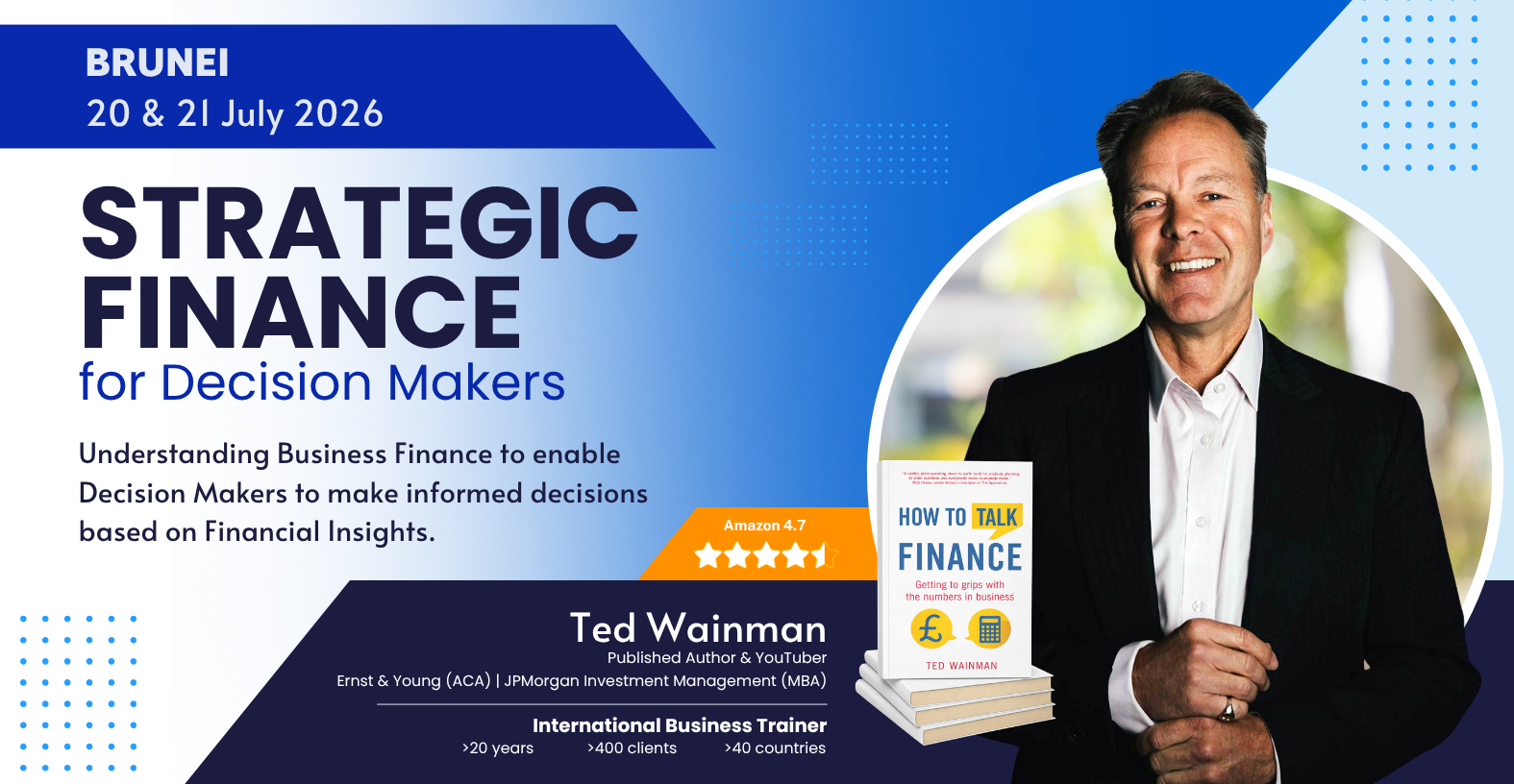
20-21 July 2026
Brunei
Radisson Hotel Brunei
Overview
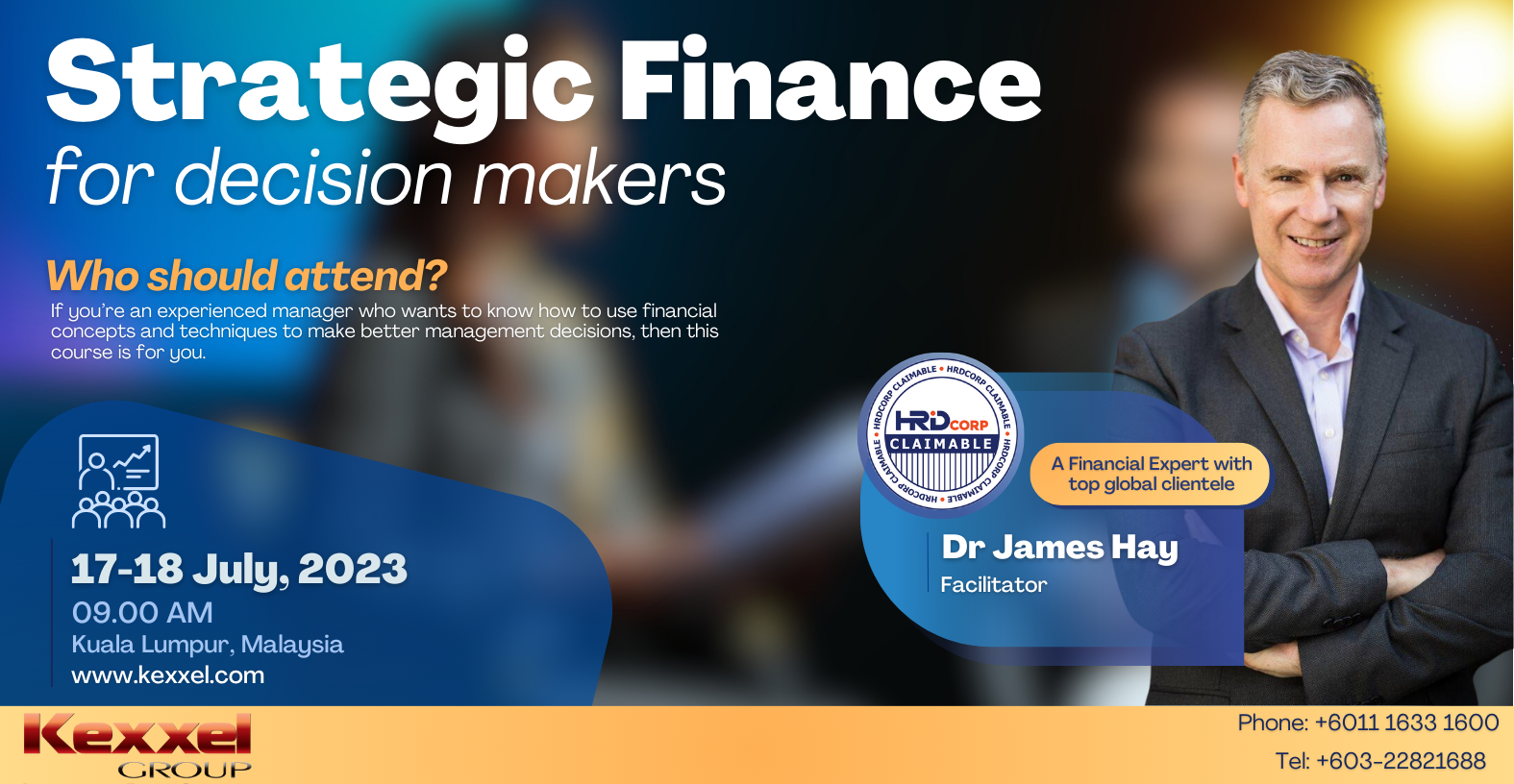
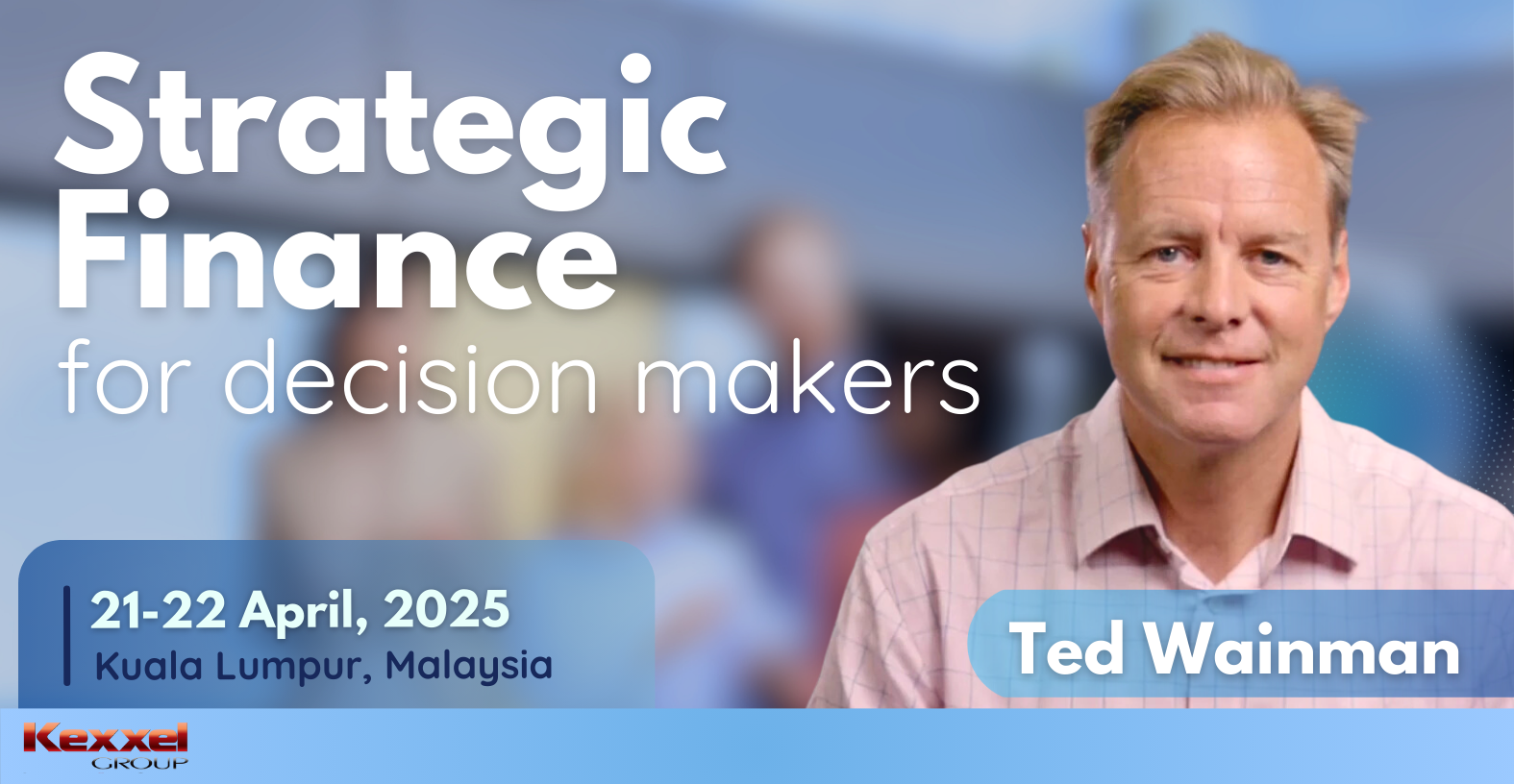
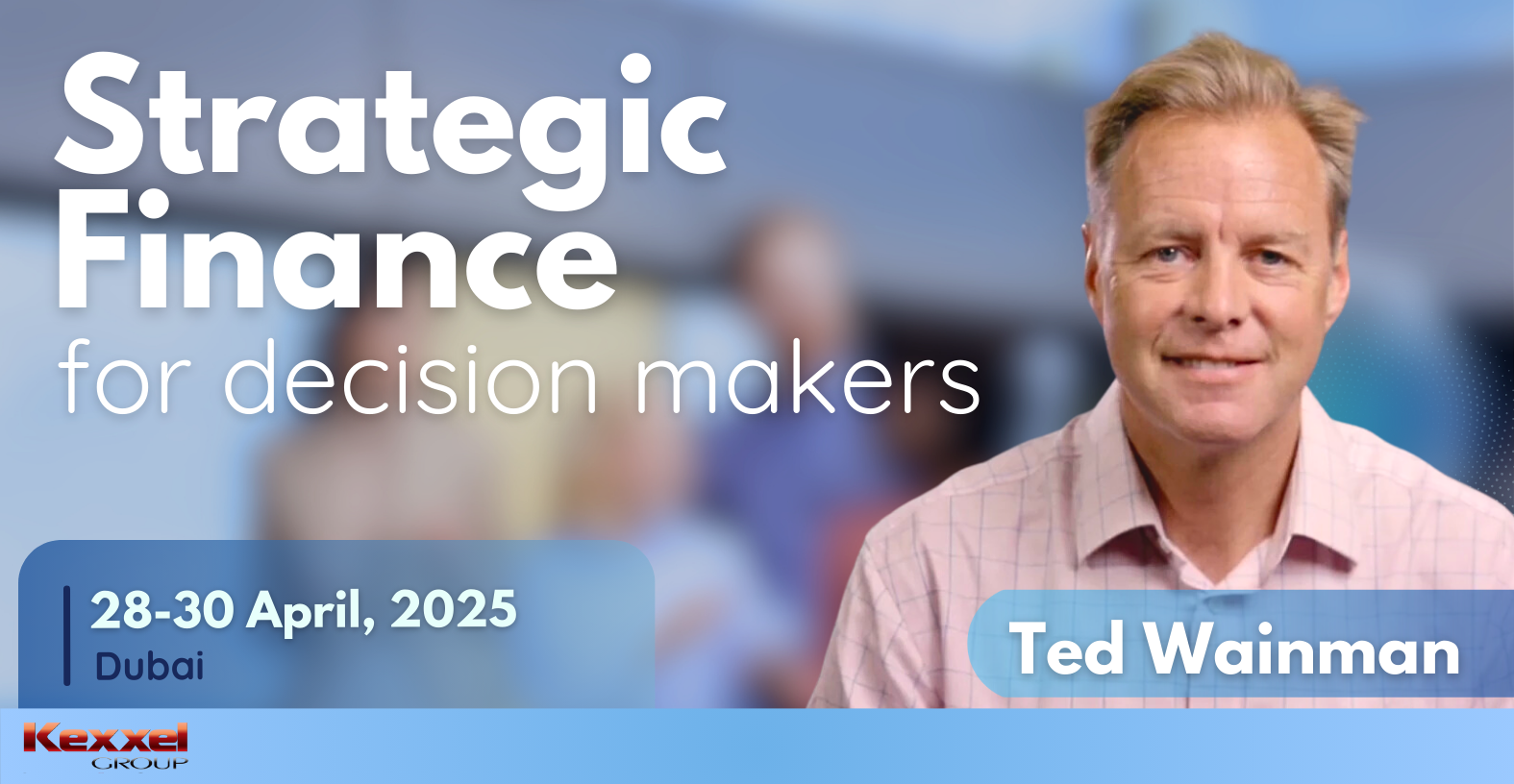
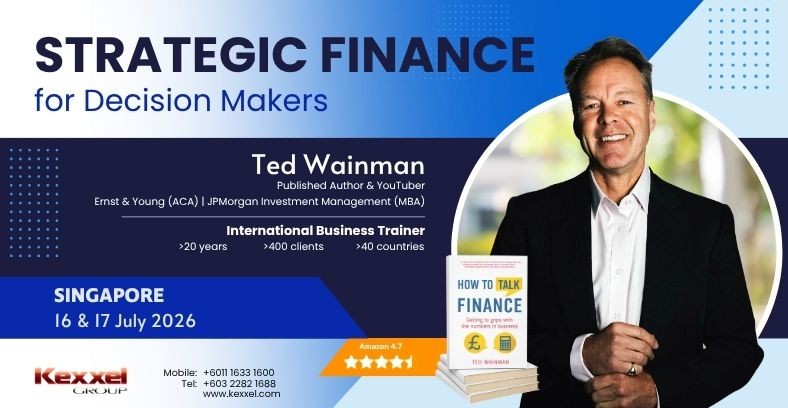
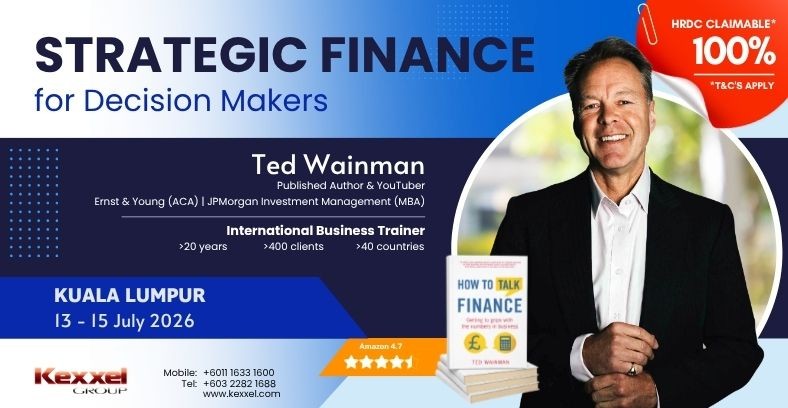
Join the Strategic Finance for Decision Makers Masterclass with internationally renowned trainer, author, and speaker, Ted Wainman. You will learn practical financial insights needed to interpret key metrics, evaluate opportunities, and connect financial outcomes directly to strategic actions to create sustainable value for your organisation.
Why Attend?
Every strategic decision has a financial consequence. Leaders who understand the financial drivers of their business consistently make better decisions. Many strategic decisions fail not because of poor strategies, but because leaders lack financial insight behind the numbers. This workshop will help you understand the financial drivers of business performance to make decisions with greater clarity and confidence.
Who Should Attend?
This seminar is specifically designed for decision makers who see their future management role as requiring greater understanding of financial concepts to assist them in making sound management decisions.
Suitable for executives from all functional backgrounds who may or may not have an accounting or finance background, including:
- CEOs & Managing Directors, Board Members
- Divisional and Regional Directors
- Heads of Departments & Budget Holders
- General Managers & Finance Managers
- Strategic Planning, Project Managers
- Managers in Operations / Marketing / HR / IT / Sales
- Technical Managers & Senior Engineers
Benefits for Participants – What Will You Learn by the End of This Course?
- Financial Insight for Better Decision Making
- Understanding the strategic trade-offs between Debt and Equity financing.
- Interpreting key performance metrics such as EBITDA and ROCE in a capital intensive business.
- Calculating the cost of capital using WACC and CAPM to support investment decisions.
- Evaluating Investments and Creating Value
- Applying Discounted Cash Flow (DCF) techniques using NPV and IRR.
- Understanding how organisations create value through Economic Value Added (EVA).
- Interpreting valuation metrics such as Yields and PriceEarnings (PE) ratios.
- Strengthening Financial Control
- Understanding the role of Liquidity and Working Capital Requirement (WCR).
- Distinguishing between Operating, Free and Net Cash Flow.
- Using budgeting and forecasting to deliver operational strategy
Rave Reviews
“Overall, Ted was able to present the facts very clearly and objectively. The event’s main strength was the course itself.”
-Hajah Siti Hasrainah, CEO, Hospital PMMPMHAMB Tutong, Brunei.
“Ted Wainman was excellent, easy to understand, and the topics covered such as CAPM, WACC were a good highlight. Kexxel Group provided excellent hospitality.”
-Mohd Ezzuan, CFO (Praline Project), TNB Power Generation.
“It was a very good training. Kexxel Group provided very good service. The event’s main strength was the trainer.”
-Dato' Mohammad Azhar, Senior Deputy CEO, Penang Development Corporation
“Didn’t know finance subject can be entertaining and substantive. Congrats TED!”
-Awang Mohd Yazrif, Senior Manager, Investment & Strategic Business, Qhazanah Sabah Berhad
“The main strength of the event was the content.”
-Sainursalwa Sani, Chief Human Resource Officer, Bank Pembangunan Malaysia Berhad
“Ted Wainman is a very clear and knowledgeable trainer, and was a strong highlight of the event”
-Pei Ping Choo, Carlsberg Brewery Malaysia Berhad, Head of Corporate Finance
COURSE FACILITATOR

Ted Wainman
Published Author & YouTuber Ernst & Young (ACA) | JPMorgan Investment Management (MBA) | International Business Skills Trainer
Achievements
Ted Wainman is a highly experienced business trainer and keynote speaker specialising in financial, commercial and strategic capability building for managers and senior professionals. Ted began his career at EY (Ernst & Young), where he trained and qualified as an Associate Chartered Accountant (ACA). He then spent six years at JPMorgan Investment Management, rising to Vice President, and completed a company-sponsored MBA in International Management of Financial Services, graduating top of his class with merit.
Since 2003, Ted has designed, developed and delivered practical, high-impact learning programmes for both the private and public sectors. He works closely with senior stakeholders to ensure training is commercially relevant, tailored to the organisation’s strategic objectives, and focused on delivering sustained behavioural and decision-making change.
With a strong foundation in finance, Ted’s core focus is on:
- Financial and commercial awareness
- Strategy and leadership
- Reading and interpreting financial statements
- Global Macro-Economics and market dynamics
Ted has a focus on financial and commercial training (including finance, strategy & leadership and Global Macro Economics). Ted has worked with over 400 companies – primarily private or listed – from blue chips to financial services, including banks, building societies and insurance companies. He has worked in more than 35 countries globally and is experienced in addressing the needs of programmes across varying cultural backgrounds.
He delivers training through:
- Face-to-face workshops
- Live virtual programmes (Microsoft Teams, Zoom, Adobe Connect and similar platforms)
- Recorded and on-demand learning solutions
Has Worked With






Trainer Videos
Book(s) Published
Agenda
Strategic Finance for Decision Makers
During the workshop we will be examining a number of Case Studies. Delegates are encouraged to bring their own accounts or those of their competitors, which will also be used as Case Studies during the workshop to ensure the concepts are clearly explained and their relevance understood.
Day 1
Examine Financial Drivers at a big picture level for strategic decision making
Financing the Business: The Cost of Capital
We start the workshop understanding how a business is financed through debt and equity – and learn the advantages and disadvantages of each.
- Capital – Debt & Equity
- Transfer of Risk
- Advanced funding – Debt, Equity, Loans, Bonds & Derivatives
- The role of banks in the Capital Markets
Case Study: How A Business is Funded
Generating a Return on Capital
Building on session 1, we then start to look at how companies measure the return on the capital that is invested.
- Profit, EBIT, and EBITDA
- Measuring ROI, ROCE, & ROA
Case Study: Calculating the ROCE
Calculating the Cost of Capital & Value Creation
Having established the return that capital is generating for an organization, we then turn to calculating the cost of that capital.
- Cost of Debt
- Cost of Equity (CAPM)
- Calculating the WACC
- Calculating EVA
Case Study: Calculating the WACC & EVA
Working Capital
Having established the importance of Investment Capital and ensuring that the return on that Capital exceeds the Cost of the Capital, we focus on Working Capital – that keeps the business alive on a day-to-day business
- Liquidity & Working Capital
- Calculating the Working Capital Requirement (WCR)
- Cash is King: operational decisions to improve the WCR
- Cash Flow analysis – OCF, FCF & NCF
Case Study: Calculating the WCR
Time Value of Money
CapEx and investment decision making is based on the ROCE / WACC / EVA principles will involve more detailed analysis including:
- The Time Value of Money
- Calculating the NPV
- Calculating the IRR
- Decision making
Practical Exercise in Excel to choose between various projects. Please bring your laptop.
Day 2
A Granular Look at the Organisation’s Finances from an Operational / Departmental Level
We will review and consolidate the material and concepts – giving more practical application of the concepts covered to new case studies and organisations.
Review of Day 1
Budgeting and Forecasting
Using budgets and forecasts to deliver on the strategy of the organisation.
- Linking Strategy to budgets
- Top down v Botton up budgeting
- Incremental v Zero Based Budgets
- How budgets add value to an organisation
The Concept of Free Cash Flow
Techniques based on free cash flow have become the predominant way of determining the value of any business. When considering an acquisition or takeover free cash flow is used to establish the right price to pay to acquire the target business. Free cash flow also allows managers to understand whether a business is growing in a way that is balanced and sustainable. As such, understanding free cash flow is essential for senior managers.
- Profit and cash flow
- How you can be profitable and broke
- Estimating free cash flow
- Using free cash flow to value a business
Practical Exercise: What would you pay to acquire a company?
Creating Economic Value
The method of measuring organisational success is changing from profit-based methods to value-based methods. These days the economic objective of businesses is to create value rather than create profits. To be a successful manager you need to understand the difference between value and profit and to know how you can create economic value in your role.
- Accounting value, market value, and economic value
- Why is value different than profit?
- How you can create economic value
- Measuring value created
- Economic Value Added (EVA)
Value Creation
This final session links the operational decisions in day 2 to the organisational decisions from day 1 and examines how to ‘create value’ in an organisation.
- Relative vs absolute valuation
- Yields & PE ratios
- Property, Shares & Bonds – valuation fundamentals
- The impact of Risk and Interest Rates on Asset Valuation
- Irrational Exuberance – how to spot a bubble
Valuation of the Case Studies covered during the workshop
TESTIMONIALS
Check out the testimonials from our events

Sharifah Noralina bt Syed Yassin
HR Director
Dutch Lady Milk Industries Berhad
Strategic Finance for Decision Makers
“The facilitator was engaging and able to translate finance into very business-centric focus. He was the main strength of the event.”

Azmi Abu Samah
General Manager (Operations)
Sime Darby Engineering Sdn Bhd
Strategic Finance for Decision Makers
“An excellent presenter & technical knowledge. Course content was very useful. Excellent organizers!!!”

Christine Lee
Managing Director
Medi-Life (M) Sdn Bhd
Strategic Finance for Decision Makers
“The facilitator did a great job presenting a difficult topic. Topic and trainer were the main strengths. Really well done!!! One of best trainings I have ever attended.”

Tan Sri Muhammad Ismail
Chief Executive Officer
Weststar Aviation Services
Strategic Finance for Decision Makers
“The facilitator is an excellent trainer. He knows his subject intimately and is able to present it in a simple way & I’m very impressed with him!”

Mohamed Iqbal
Chief Operating Officer
Pharmaniaga Berhad
Strategic Finance for Decision Makers
“The facilitator is a very knowledgeable speaker as he was able to clearly put his message across. The best part is, he covers not just for financial guys, but also ordinary guys. So if it is him, I would definitely recommend to anyone.”

Rosmawati Zainuddin
Senior General Manager, Treasury Division
PERKESO
Strategic Finance for Decision Makers
“For myself having a strong finance background I find the course to be a good refresher. I find this course useful in terms of how I can explain complicated finance term to my staff who don’t have finance background and personally that’s my take-away. This can definitely help me in my career.”

Lum Joy Deng
Director of GAM1 Business Planning
CIMB Investment Bank
Strategic Finance for Decision Makers
“I find the course to be a good refresher. The facilitator provide me a good perspective when we look into numbers and how can they can be used to interpret our business. I can definitely use this in my career seeing that I’m working in a banking institution. The facilitator’s delivery was extremely good and detailed."

Mohd Fariz Mohd Zain
General Manager
UMW Advantech
Strategic Finance for Decision Makers
“The training was well presented and concepts were well understood. I feel this event would be an excellent choice for non-finance practitioners who need to employ decision-making with a financial basis. I found the facilitator and the methodology of the training to be the main strengths of the event!”

Wan Mohd Fadzlullah
Executive Vice President
Takaful Ikhlas
Strategic Finance for Decision Makers
“This was very detailed course which enriched us with a lot of proven concepts. I loved the facilitator, he is very experienced in his field and all his examples could be related to the real life situations. Very good organization of the training thanks to Kexxel.”

Khaidhir Elias
Vice President of Marketing
Telekom Malaysia
Strategic Finance for Decision Makers
“..Very good program, very nice, very informative speaker and presenter, very easy to understand the module presented for both beginners and advanced users. In terms of relevance to our business, yes for those who have great exposure to finance, this is very good program for them. I would like to recommend to every executive regardless they are in product development or engineers because one way or another they actually have to understand finance figures…Overall, very satisfying experience and exposure I got by attending this program. We actually see that it is very useful and we would recommend it to other staff within our organization..”

Azmi Bin Abu Samah
Sr General Manager
Sime Darby Engineering Sdn Bhd
Strategic Finance for Decision Makers
“..I have been in this industry for 20 years. I think this event is good exposure for non-financial people. The facilitator was quite comprehensive, not that difficult to understand. I like the content, it refreshed my memories. I would definitely recommend it to others..”

Mohd Khiri Abd Wahab
Vice President
Sime Darby Plantation Sdn Bhd (Malaysia)
Strategic Finance for Decision Makers
“Clear and informative presentation. The strength of the event was the reputation of the facilitator.”

Graeme Read
EVP Chief Strategy Officer (Asia Pacific)
McCann Health
Strategic Finance for Decision Makers
“The facilitator gave very clear, good mix of examples, humor, as well as stories to bring ideas and principles to life. It has a good pace. The highlight of this event is the broad overview of financial principles and terminology, along with good handout materials.”

Eileen Tan Seok Ling
Director
Singapore Telecommunications Ltd (Singapore)
Strategic Finance for Decision Makers
“The facilitator makes complicated concepts practical and simple to understand.”

Ng Cher Keng
Director
Civil Aviation Authority of Singapore
Strategic Finance for Decision Makers
“The facilitator was able to put things across in a way that helped a non-finance person grasp the key essence of the subject.”

Alexander
CFO
Sarawak Energy (Malaysia)
Strategic Finance for Decision Makers
“The facilitator made a complex financial subject simple and interesting. Efficient organizer.”

Shafik Azlee Mashar
Head Internal Audit
Maxis Broadband
Strategic Finance for Decision Makers
“For me I learnt quite a number of things from this training, most of the terms used are familiar to me but hearing the facilitator explain the terms in a layman’s language, and has given me a better understanding. As I don’t have a finance background, this course helped me understand some of the terms that I use every day in my job. If your job requires you to look at figures and the health of the company then you should attend this course. I found the training good and the material provided very useful to me.”

Ahmad Fuad Bin Md Kasim
General Manager
Tenaga Nasional Berhad
Strategic Finance for Decision Makers
“The facilitator was very clear and give out good example for easier understanding. He was able to translate finance into business centric focus. His knowledge in finance is the main strength of this event!”

Raja Ahmad Shazli
Head Office of Strategic Initiatives
Mesiniaga
Strategic Finance for Decision Makers
“The facilitator did a fantastic job of taking the complexities of understanding finance and made it simple & easily understood. Hence why I believe that the facilitator and the topic presented were the main strengths of the event.”

Ahmad Nasri bin Mohamed
Vice President
Telekom Malaysia
Strategic Finance for Decision Makers
“The facilitator was able to explain strategic finance in a very practical manner. He strives to find simplicity in giving us a fundamental understanding of the financial principles. He also showed us how to use the knowledge we have gained into practical situations. I think this is a great course and the trainer is fantastic.”

Mohamed Azukarais Mohd Di
Head of Strategic Planning
Axiata Business Services
Strategic Finance for Decision Makers
“I came to this event to gain more knowledge. The training was a refresher course for myself. The knowledge I gained from this training can be applied in my career. I would encourage my colleagues to join this event, so they can gain more knowledge when it comes to making financial decisions. The facilitator is an amazing trainer."

Michael Chung Wing Kay
CCO
CCM Chemicals
Strategic Finance for Decision Makers
“Complexity made simple! It was easy to understand the financial concepts due to the practical articulation by the facilitator. I loved the content of the course as it is relevant to my work.”

Alexander
CFO
Sarawak Energy
Strategic Finance for Decision Makers
“The facilitator made a complex financial subject simple and interesting.”

Sharifah Noralina bt Syed Yassin
HR Director
Dutch Lady Milk Industries
Strategic Finance for Decision Makers
“The facilitator was engaging and able to translate finance into very business-centric focus. He was the main strength of the event.”

Khairil Azman Ismail
Chief Operating Officer
NUR Power
Strategic Finance for Decision Makers
“The training is a good refresher for finance professionals but also great for people from a technical background. Kexxel Group did a great job with the event set-up.”

Magdy Tadrous
General Manager
Petrochem Performance Chemicals Ltd (UAE)
Strategic Finance for Decision Makers
“Excellent flow of information! Kexxel was excellent and the exercises were the strength of the event.”

Khaidhir Elias
Vice President, Marketing
Telekom Malaysia
Strategic Finance for Decision Makers
“..Very good program, very nice, very informative speaker and presenter, very easy to under[1]stand the module presented for both beginners and advanced users. In terms of relevance to our business, yes for those who have great exposure to finance, this is very good program for them. I would like to recommend to every executive regardless they are in product develop[1]ment or engineers because one way or another they actually have to understand finance figures…Overall, very satisfying experience and exposure I got by attending this program. We actually see that it is very useful and we would recommend it to other staff within our organization..”